5 Essential Tips for Reading Floor Plans
Imagine this: You’re looking at real estate listings and see what appears to be the perfect house. The pictures are beautiful, the location is perfect, and the pricing is right for you. But when you click on the floor plan, it seems like a puzzle drawn by someone who speaks a language you don’t understand. You see lines, symbols, numbers, and abbreviations swimming in front of your eyes, and you wonder if you need a degree in architecture simply to find the bathroom.
If this scenario sounds familiar, you’re not the only one. At first glance, floor plans may appear intimidating, but the reality is that mastering the art of reading them is an invaluable skill, whether you’re buying a home, renting an apartment, renovating your current space, or simply contemplating your future dream home.
Knowing how to read floor plans gives you a whole new set of options. You can now see any concerns before you even set foot in a property. You can visualize where the furniture will go, check for any traffic flow issues, and determine whether that “spacious master bedroom” is genuinely spacious or just a well-angled shot. You can quickly rule out properties that aren’t right for you from your computer, and when you go to viewings, you’ll have smart questions ready that show sellers and agents that you’re a serious, knowledgeable buyer.
The best part? It may seem hard to read floor layouts, but it is not difficult at all. These architectural drawings go from being complex schematics to really helpful tools that teach you practically everything you need to know about a space once you learn a few basic rules and common practices.
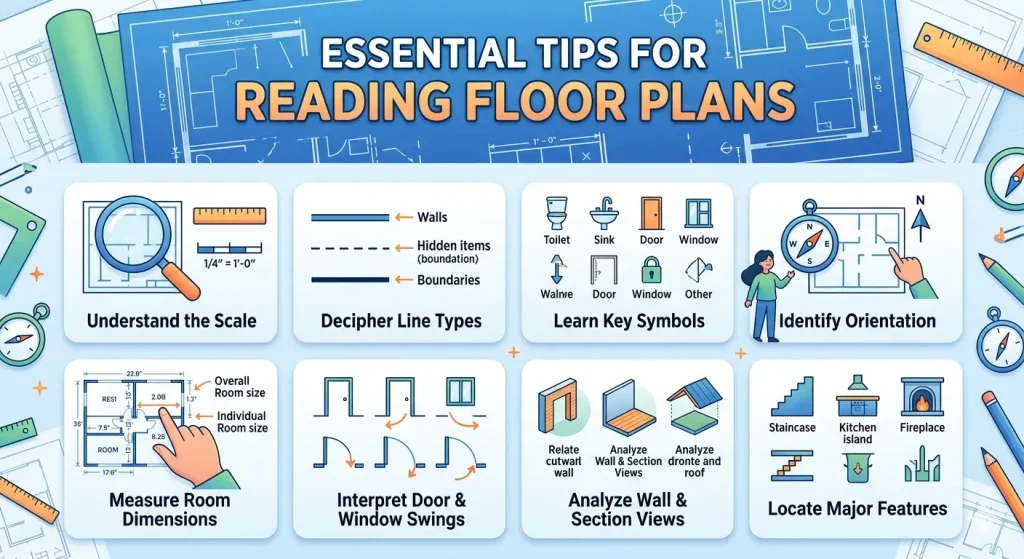
In this complete guide, I’ll give you five important tips that can turn you from a beginner at reading floor plans into someone who can do it with ease. We’ll explain the symbols, figure out the proportions, and help you improve your ability to picture things in three dimensions. You’ll wonder how you ever searched for a house without this information.
Let’s get started and find out what those lines and symbols are hiding.
Tip 1: Master Scale and Measurements – The Foundation of Floor Plan Reading
You need to know what scale means before you can learn anything else about a floor plan. This concept is very important, yet it’s where most people mess up right away.
What Scale Really Means
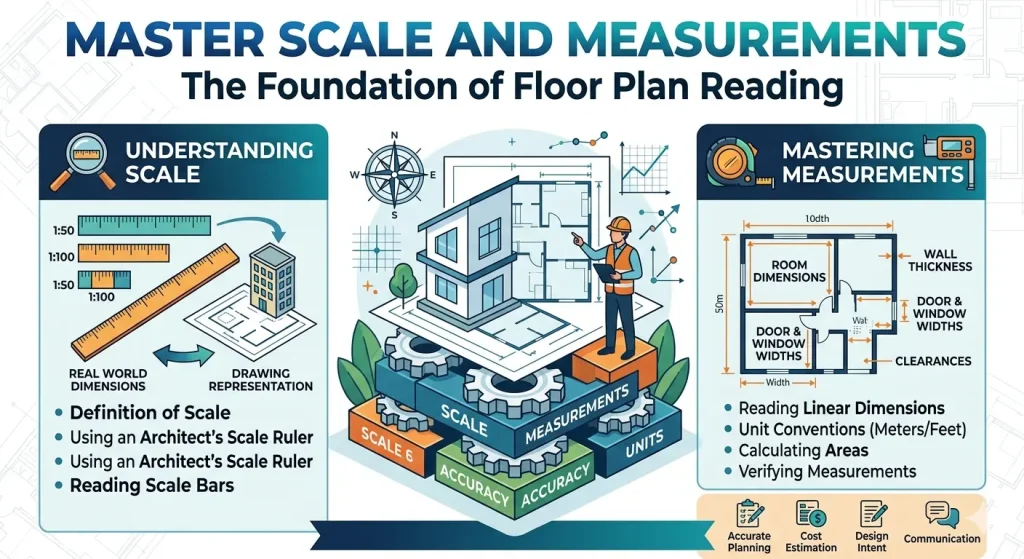
Scale is the difference between the design’s dimensions and the real space’s measurements. Floor plans are small pictures of real buildings, and the scale informs you how much smaller the picture is than the real thing.
You can usually observe scales printed like “1:100” or “1/4″ = 1’0”. The first format (1:100) is metric, which implies that one unit on the design is equal to 100 units in real life. In the real building, one centimeter on paper is 100 centimeters (one meter). The second format (1/4″ = 1’0″) is imperial, which means that every quarter-inch on the drawing stands for one foot in real life.
Some common scales for home floor plans are the following:
- 1:50 or 1/4″ = 1’0″ for plans with a lot of detail.
- 1:100 or 1/8″ = 1’0″ for blueprints of the full house
- 1:200 or 1/16″ = 1’0″ for site plans or big properties.
Why This Is More Important Than You Think
Knowing how to read a scale might help you avoid one of the most common mistakes people make when reading floor plans: getting the sizes of the rooms wrong. That bedroom may seem big on the plan, but if you don’t consider scale, it might only fit a queen bed.
If you have a floor plan with a 1/4″ = 1’0″ scale, you can see that the living room is 2 inches by 3 inches. To determine the actual sizes, you would perform the calculations: 2 inches divided by 0.25 equals 8 feet, and 3 inches divided by 0.25 equals 12 feet. So, your living room is 8 feet by 12 feet, or 96 square feet. This is useful information to have when you try to figure out if your sectional sofa will fit.
Read the dimensions the easy way.
The good news is that most modern floor plans have written dimensions, so you don’t have to use a ruler and calculator every time. There will be numbers on the walls that show measures, normally in feet and inches (such as 10′-6″ for ten feet, six inches) or in millimeters and centimeters for metric plans.
Pay close attention to:
- Overall size of the room: Usually shown as length × width
- Wall lengths: Important for planning renovations and where to put furniture
- Door and window sizes are particularly important for getting in and out and delivering goods.
- Ceiling heights: Sometimes listed separately; however, in modern homes, they are usually 8 to 10 feet high.
- Quick tip: Make a list of the sizes of your furniture that you can look up quickly. Your sofa is 7 feet long, your dining table is 6 feet long, and your king bed is 6.5 feet wide. This lets you “place” your furniture in the floor plan as you look at it, so you can quickly tell if the areas will work for you.
It’s not just about arithmetic to understand size and measurements. It’s also about getting a true sense of space that will help you identify, evaluate, and eventually live in your home.
Tip 2: Decode the Symbols and Abbreviations – Learning the Floor Plan Language
If measurements are the basis for interpreting floor plans, then symbols and abbreviations are the words. There is a standard visual language for all floor plans, and once you master it, these designs become much easier to understand.
Door Symbols: Not Just an Opening
A door is usually portrayed as a straight line (the door itself) with an arc that shows which way it swings. This symbol may look simple, yet it says a lot:
- The direction of the swing is important. A door that swings into a room takes up space on the floor and changes where furniture can go. A door that swings into a small bathroom could be in the way of the toilet or vanity.
- Standard interior doors are 30 to 36 inches wide, while standard external doors are 36 inches
- wide. Minimum height for accessibility is 32 to 36 inches.
- Sliding doors look like two rectangles that overlap, pocket doors look like a door sliding into a wall hole, bifold doors have zigzag lines, and French doors look like two doors with swing arcs.
- I once worked with a client who fell in love with an apartment based on pictures, but the floor plan showed that the bedroom entrance opened right into where a normal dresser would go. The photographs didn’t make it clear, but the floor plan conveyed the whole tale, and she decided to keep looking.
Window Symbols: Things to think about with light and view
People usually draw windows as holes in walls with lines that run parallel to each other to depict the glass. Different types of windows have different symbols: - Standard windows: Three lines that run parallel to each other in a wall break
- Bay or bow windows go past the wall line.
- Sliding windows: Show parts that overlap
- Fixed windows: They could look like a simple opening with no operating signs.
Windows determine how you arrange your furniture (you can’t put a tall bookcase in front of one), how much natural light comes in (important for home offices or plant enthusiasts), and how private your home is (ground-floor windows facing neighbors could need treatment).
Staircase Symbols: Learning How to Move Up and Down
Stairs are displayed as a sequence of parallel lines with an arrow pointing up or down from the current floor. Along with the number of risers, you’ll often notice “UP” or “DN” written on them. This information helps you get it:
- How much floor space stairs take up (which is surprisingly a lot)
- Where vertical circulation stops the flow of a level
- Possible problems regarding accessibility for people who have trouble moving around
- Common Short Forms You Will See
A lot of shorthand is used in floor plans. These are the most prevalent short forms: - WIC stands for “walk-in closet.”
- W/D: Where the washer and dryer are
- DW: Dishwasher
- REF: Where the refrigerator is
- HVAC stands for heating, ventilation, and air conditioning.
- WH: Water heater
- CL or CLO means “closet.”
- CLNG: Roof
- FP: Fire Place
- Symbols for Plumbing and Electricity
More comprehensive floor drawings depict plumbing fixtures, electrical outlets (represented as circles with lines), and light switches (S with a line pointing to the fixture). These may seem like small things, but they are very useful:
Where you can put electronics, lighting, and charging stations depends on where the outlets are.
Changing the location of switches can make illumination more convenient and rooms more useful.
The location of plumbing fixtures lets you know if you’re looking at a full bath (toilet, sink, tub/shower) or a half bath (toilet and sink only).
Material Signs
Some floor layouts indicate materials by using varied fill patterns or hatching: - Brick or stone could have patterns that are spotted or rough.
- Concrete looks like many small dots.
- Different designs could show different types of flooring.
- Making Your Own Key for Symbols
Here’s a useful tip: print out or save a basic symbol legend and bring it with you when you search for a new home. Even better, after looking at a few floor plans, make your own cheat sheet with the symbols and abbreviations you see the most. This unique reference guide can help you read your floor plan much faster.
These symbols aren’t random; they’ve been used for decades to transmit spatial information in a clear and efficient way. Once you can read them easily, you’ll get more information from a two-minute inspection of a floor plan than you would from an hour of scrolling through photographs that are precisely angled.
Tip 3: Visualize Space and Flow – Thinking in Three Dimensions
It’s one thing to read the symbols and measurements; it’s another to really know how a place will work in real life. This is when you go from just looking at a floor plan to really understanding what it means to live there.
Getting to Know Traffic Patterns
One of the most important things to know when reading a floor plan is how people will move around in the area. Look for natural paths from the following:
- The main door to the living spaces
- The kitchen and dining rooms
- From bedrooms to bathrooms
- From living rooms to outdoor areas
Good traffic flow means that these paths don’t go through the middle of rooms or make it difficult to go around. For example, if the only route from the bedroom to the bathroom is through the kitchen, it can be quite inconvenient at 2 AM.
Think about the layout: does the front entrance lead straight into the living room, or is there a hallway or foyer? The second option creates a space between your guests and your personal area so they don’t stroll right in. Is there one way to the kitchen that could cause traffic jams?
The Room Relationship Principle
The greatest floor layouts carefully categorize rooms by what they do:
- The entrance and the living room, dining room, and kitchen are usually close to each other.
- There are distinct regions for private spaces (such as bedrooms and baths) and public places.
- There are quiet spaces (such as bedrooms and the home office) and noisy areas (like the kitchen, laundry room, and playroom).
A floor plan that puts the master bedroom directly next to the living room might seem like a good use of space, but it can be difficult to sleep when your teenager is having movie night.
A home office next to the laundry room sounds wonderful until you’re on a video call and the spin cycle starts.
Seeing how furniture will fit
Seeing how furniture will fit in your new home is where your previous work on understanding scales truly helps. As you look at each room, think about where your furniture will go:- In the bedroom: Where will the bed go? Can it fit on the wall without impeding any windows, doors, or closets? Are there nightstands on both sides?
- In the living room, can you make a place for people to talk? Where is the TV going to go? Is there enough room for both sitting and moving around the furniture?
- In the dining room: Will your table fit with enough space for seats to pull out and guests to move around?
Remember these standard furniture clearances:- 30 to 36 inches for paths around furniture
- 24 to 30 inches to draw out a chair at the table
- Maintain a distance of 42–48 inches in front of kitchen cabinets when cupboards or appliances are on the opposite side.
Things to think about when it comes to natural light and views
Windows are more than simply shapes on a design; they let in natural light and provide you a vista. Think about:
- Orientation: Which way do the principal windows face? Windows that face south let in the most light (in the Northern Hemisphere), whereas windows that face north let in softer, more even light.
- The number and size of windows: A room with one little window will seem very different from a room with many or large windows, even if the square footage is the same.
- Placement of windows in relation to furniture: Will the windows let in lovely light where you’ll be sitting or working?
The Analysis of the Open Plan
Many modern homes have living spaces that are open to each other. Such designs seem like big spaces on a floor plan, with no boundaries between the kitchen, dining room, and living room. The layout looks big and open, but consider the following: - How will you separate different areas without walls?
- Where are the structural parts (such as beams and columns) that could stand in the way of the openness?
- How will the sound arrive there? The open design allows sounds from the kitchen to reach the living and dining areas.
- Is there too much openness? Some people say they miss having separate spaces for different hobbies.
Making your own 3D model in your head
The best thing you can do is learn how to turn a two-dimensional floor plan into a three-dimensional mental representation. You need to practice this skill; however, here are some tips that can help:
Start with one room: Pick a room, figure out how big it is, where the doors and windows are, and then close your eyes and picture yourself standing in the middle. What do you observe in all directions?
Use virtual staging: Some websites and applications let you put furniture on floor plans digitally, which makes it simpler to see what it will look like.
“This living room is about the same size as my current bedroom.” These kinds of comparisons help you get a better sense of space.
Bring floor plans with you when you visit properties: When you tour properties, bring the floor plan with you. This contrast to the real world speeds up your learning curve by a lot.
The more you practice this kind of three-dimensional thinking, the better you’ll be at guessing if a space will meet your demands before you go there in person. This one talent can save you a lot of time by letting you avoid looking at properties that aren’t right for you.
Tip 4: Identify Structural Elements – Understanding What Can and Cannot Change
Knowing how to read floor plans lets you tell what’s fixed and what’s changeable. This information is essential, whether you’re looking at a property’s potential for renovation or just trying to understand how strong it is.
Walls That Hold Up Weight vs. Walls That Don’t
This is probably the most crucial structural difference in residential buildings. Load-bearing walls hold up the weight of the building above them. If you take them out without making the structure stronger, the building could fall down. Partition walls, also known as non-load-bearing walls, merely divide space and can be easily removed.
On floor plans, load-bearing walls are often shown by:
- Lines that are thicker than partition walls
- Walls that run perpendicular to floor joists
- Walls on the outside (that are virtually invariably load-bearing)
- Walls directly below other walls on upper floors
- Walls marked with certain symbols or patterns
But here’s the most important thing to remember: you can’t tell for sure if a wall can hold a load just by looking at a floor plan. This always needs an expert to look at the structure. That being said, knowing who the likely options are will help you ask better questions and have reasonable hopes for the remodeling.
I remember a couple who wanted to take down the wall between their kitchen and living room to make their main floor more open. The floor plan suggested this wall might be load-bearing (it was centrally located and aligned with the wall above), and they wisely consulted a structural engineer before making an offer. It was load-bearing, and while it could be taken down, it would cost an extra $15,000 to do so. This was critical information they needed before buying.
Columns and Posts
Columns shown on floor plans indicate vertical structural supports, often found in:
- Basements that hold up beams on the main floor
- Open-concept spaces where walls have been removed but support is still needed
- Covered porches or patios
These are permanent parts that can’t be moved without a lot of effort on the building’s part. If a column appears in the middle of what seems like a wide-open living space, that’s the reality you’ll be living with (or designing around).
Limitations of Mechanics and Utilities
Some floor layouts include systems that are difficult and expensive to relocate:
Plumbing fixtures can be found in bathrooms, kitchens, laundry rooms, and other places. The best way to arrange plumbing is to stack wet spaces vertically (like an upper-floor bathroom over a main-floor bathroom) or combine them horizontally (like a kitchen and bathroom sharing a plumbing wall). You can move plumbing, but it will cost a lot, especially if your foundation is made of concrete.
Renovations depend on the placement of ducting, air handlers, and furnaces in HVAC systems. A furnace in a central closet might limit your ability to reconfigure surrounding rooms.
Electrical panels: Main electrical service panels need to remain accessible and are expensive to relocate.
Chimneys and flues: These vertical parts usually go from the basement to the roof and are important structural parts that shouldn’t be changed without professional help.
Indicators of the foundation and floor structure are important to assess.
Some detailed floor plans include information about:
- Type of foundation (slab, crawl space, or full basement)
- Direction of the floor joists (indicated with arrows)
- Beams and headers for structure
The direction of the floor joists is important because walls that run perpendicular to the joists are more likely to be able to hold weight. Knowing your foundation type will help you determine if you can finish your basement, if there are moisture issues, or if you can expand later.
What This Means for You
Knowing about structural elements can aid you in several ways:
- Realistic renovation assessment: You can tell the difference between a simple cosmetic update and a renovation that is more complicated structurally.
- Budgeting: Knowing that you need to take down a load-bearing wall to get the open floor plan you want helps you budget correctly (usually between $1,500 and $10,000+, depending on the span and structural solution).
Some people refuse to consider properties that lack easy modification, while others are content with their current state. Understanding what’s possible helps you decide which camp you’re in.
“Is this a load-bearing wall?” and “Where is the main plumbing stack?” are two good questions to ask during viewings that demonstrate sellers and agents that you’re a serious, knowledgeable buyer.
The Principle of Professional Consultation
This principle is the most important thing I can tell you in this section: floor plans can help you with your inquiries and first assessment, but you should always hire qualified professionals to make structural decisions. Architects, structural engineers, and skilled contractors can provide you answers that floor plans alone can’t, such as insights into load-bearing structures, compliance with building codes, and recommendations for materials and construction methods.
The floor plan is the first thing you should look at. The blueprint is not a building guidebook; it is a beginning point for dialog. It assists you in identifying houses with solid foundations and potential for renovation.
If you know about structural elements, you can go from just seeing rooms to understanding the whole building. This deeper knowledge is very helpful when it comes to making smart real estate decisions.
Tip 5: Read Between the Lines – Understanding What Floor Plans Don't Show
If you follow the first four guidelines, you’ll be able to read floor plans like a pro. But this fifth technique is what makes you an expert. The most advanced floor plan readers know not only what the drawings show, but also what they don’t show. The things that remain unseen can be just as crucial as the visible ones.
The Question of Ceiling Height
Standard floor plans show two-dimensional views of horizontal space, which means that the height of the ceiling, which is a big part of how a room feels, isn’t often obvious right away. A 10×12 space with 8-foot ceilings seems very different than a 10×12 room with 10-foot or vaulted ceilings.
Search for:
- Notes on the height of the ceiling (often shown individually or in room labels)
- Indicators for vaulted or cathedral ceilings, which are commonly depicted with dashed lines or specific symbols
- Side-view cuts through the building that reveal vertical proportions.
- This question is crucial if the floor plan omits the ceiling heights.
- Ceilings in older homes might be 7.5 feet high. Modern homes usually have ceilings that are 8 to 9 feet high, and luxury homes sometimes have ceilings that are 10 feet or more tall. This isn’t a small factor; the height of the ceiling impacts everything from how big the room feels to how much it costs to heat and cool it to whether your tall furniture will fit.
Space for storage: the hidden commodity
Closets are shown on floor plans, but they don’t show how much storage space there is. A bedroom may include a closet, but is it a big walk-in closet or a small coat closet that is only 24 inches deep? You have to check the floor plan dimensions to find out.
Check storage by: - Taking measurements of the closet’s square area and depth
- Counting all the closets in the house
- Finding out if the basement, attic, or garage may be used for storage
- Searching for built-in cabinets, pantries, or storage beneath the stairs
One of the most common concerns homeowners have is that they don’t have enough storage space. It’s easy to forget about these features when you’re thinking about room sizes and layouts. A home with ample storage is much more comfortable than one where you must constantly search for a place to put your things.
The Truth About Natural Light
Floor plans show where the windows are, but they don’t illustrate how much sunlight the space gets. This assessment is based on:
- Window size: The plan should show the dimensions, but a room with one 3×4 window is not the same as a room with three 3×4 windows.
- Orientation: The direction the building faces (north, south, east, or west) affects the amount and quality of light.
- Obstructions outside: The floor plan won’t display the big tree or the building next door that blocks your would-be sunny window.
- Height of the window: Floor-to-ceiling windows let in different light than regular windows.
- Glazing and window quality: Not shown on floor layouts, but they have a big effect on how much light comes through.
If you want natural light (and you should—it’s good for your mood, health, and energy costs), the floor plan is just the start. You’ll need additional information on the orientation and the outside world.
Space and Context Outside
Usually, residential floor plans just show the inside arrangement. They may not represent much or any of the outside space or property surroundings. Search for:
- Site plans show the building’s location, external elements, distance from property borders, and orientation.
- Patio, deck, and balcony sizes: These are often shown on floor plans but are sometimes missed.
- Landscaping: The design affects how private and usable the space is, but it’s rarely shown in detail.
How near are the properties next to each other?
If your backyard is only 10 feet from your neighbor’s windows or if the land backs onto a busy street, a stunning floor plan with a flawless interior layout doesn’t matter as much.
Signs of Quality and Condition
Floor plans indicate how things are laid out, but not how well they were built or how well they are now. They don’t show:- The age and state of the HVAC, plumbing, and electrical systems
- The quality of the materials and finishes
- Problems with maintenance or repairs that need to be made
- Problems with permits or following the code
- Concerns about the environment include mold, asbestos, and lead paint.
This is why floor plans are helpful but should never take the place of professional house inspections or inspections in person.
The Livability Factors
Some parts of daily life just don’t work with floor plans:
- Noise: Is the garage above the master bedroom? Is there a partition between the adolescents’ playroom and the home office?
- Privacy: Do the windows of the bedroom look out into your neighbor’s house? Does the front walkway go by the bathroom window?
- Climate
- Considerations: Will the wall of windows that faces the sun be appealing, or will it cost a lot to cool the house?
- Accessibility: The lengths and layouts of the doors are displayed, but there may be small accessibility problems that aren’t obvious (stairs between rooms, tight corridors, and the location of bathroom fittings).
The ability to be flexible and grow in the future
Imagining the future is one of the best ways to get useful information from floor plans:- Is it possible for an extra room to turn into a fourth bedroom?
- Is there room to grow (such as finishing the basement, turning the attic into a bedroom, or adding on)?
- Can the room change to meet your needs as they change (like when you are older, need a home office, or have a bigger family)?
Check for: - Unfinished areas with potential, such as the basement, attic, or additional rooms above the garage
- Places where you can add logically without changing the layout
- Rooms that might be used for more than one thing
- Getting Better at Critiquing
To interpret the floor layouts effectively, consider the following questions: - What information do I believe is present that isn’t??
- What additional information do I require to make an informed decision?
- What may this floor layout be hiding, either on purpose or by accident?
- Not only in theory, but how would this space work for my way of life?
The goal is to understand the strengths and limitations of floor layouts, not to obsess over what isn’t shown.
Bringing together information from many sources
People who are skilled at reading floor layouts don’t just look at the plans. They work together:
- Plans for the floor (layout and size)
- Pictures (finishes, conditions, and how it really looks)
- Descriptions of the property (features, amenities, and location)
- Information about the location, such as the neighborhood, the direction it faces, and the lot’s features
- Visits in person (feel, light quality, condition)
- Professional checks of the structure, mechanics, and environment
- Each source gives you a piece of the puzzle, and floor plans are an important piece that is useful but not complete.
This all-encompassing approach to floor plans, which includes understanding what they don’t show, makes the difference between beginner floor plan readers and real estate specialists who can consistently make excellent selections.
Conclusion: From Confusion to Confidence
If you’ve made it this far, congrats! You’ve gone from being scared of floor plans to being an expert at reading and understanding these useful tools.
Let’s go over the five most important tips that can help you with any property search, renovation project, or real estate decision:
1. Learn to use scales and measurements to accurately gauge room sizes, so you don’t misjudge spaces based on how they look on paper or in pictures.
2. To read floor plans fluently, you need to be able to decode symbols and abbreviations. This will help you obtain the most information from each line and note.
3. To picture space and flow, consider in three dimensions how traffic moves, how rooms are connected, and how spaces will work in real life.
4. Identify structural parts to tell the difference between what is fixed and what is flexible. This will help you create realistic expectations for how much a structure can be changed and comprehend its bones.
5. Pay attention to the details that floor plans often overlook, such as ceiling heights, available storage space, light quality, and other factors that enhance a space’s livability.
These talents are like learning a new language. It feels strange at first, and you have to think about how to translate things. However, with practice, reading a floor layout becomes instinctive. By simply examining a plan, you’ll be able to immediately determine if a place will suit your needs. You’ll also be able to notice difficulties and opportunities that other people miss, such as identifying potential obstacles in the layout or recognizing areas that could be optimized for better functionality.
What You Should Do Next
Here’s how to use this information:
Start looking at floor plans on a regular basis. Even if you’re not actively looking for a house, look at real estate listings and study the floor plans. The more you do it, the better you’ll get.
Compare plans to real spaces: When you visit a property, bring the floor plan and see how the real space matches up with what you thought it would be like. This feedback loop helps you get better at things quickly.
Make your own reference materials: Make a symbol guide, write down the sizes of your furniture, and make a list of things to hunt for based on your needs.
Ask smarter questions: Use what you know about floor plans to ask sellers, agents, architects, and contractors smart questions.
Trust but verify: Floor plans are excellent for screening and evaluating, but you should always double-check critical features by having an expert visit the property and evaluate it in person.
The Big Picture
Reading floor plans is more than just figuring out drawings; it’s also about gaining control. With these abilities, you may make real estate decisions with certainty instead of doubt. You save time by quickly and accurately judging properties. You make better choices because you know more about spaces. And you can talk to real estate agents better since you know how they talk.
Floor plan literacy is a skill that will help you for the rest of your life, whether you’re a first-time homebuyer looking for the ideal property, a homeowner planning renovations, a renter looking at apartments, or just someone who loves learning about how places work.
What originally looked like a bunch of random lines, symbols, and numbers now tells you a story: how the space is set up, how it will work, and if it’s the appropriate fit for your life. That’s the strength of being able to understand floor plans.
Now go out and use what you’ve learned. When you view a floor plan again, you won’t be confused. Instead, you’ll see clarity, options, and chances. Have fun reading the floor layout!