4 Secret Tips for a Minimalist Home
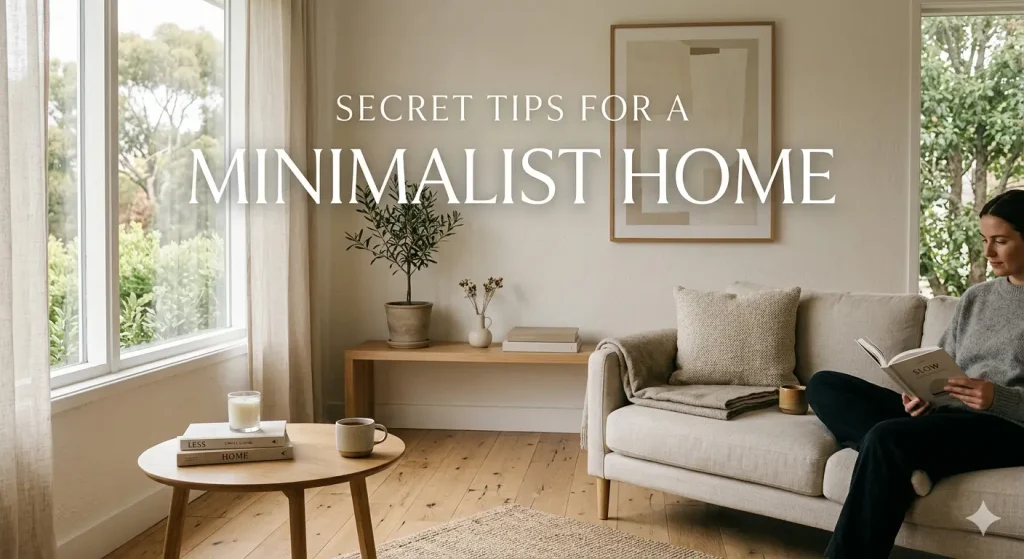
When I first heard about minimalism, I thought of those Instagram accounts that are all white with just one succulent on a marble tabletop and nothing else. Pretty? Of course. Is this lifestyle realistic for someone who has kids, interests, and a real life? Not really.
Minimalism isn’t about living in a space that feels more like a museum than a home or going without anything. It’s about being deliberate. It is about creating a space that serves your needs, rather than one that requires constant maintenance. It’s about going home and feeling like you can finally breathe instead of being burdened by all the stuff and work that needs to be done.
Over the last five years, I’ve progressively changed my home from a place where I couldn’t find my keys every morning to a place that helps me live instead of draining my energy. And no, my house doesn’t look like a Pinterest board for minimalists. There are books on the shelf, paintings on the walls, and yes, sometimes dirty dishes in the sink.
What I’ve learned is that the best minimalist tactics aren’t the ones you usually hear about. They’re not the “get rid of everything” or “count your things” ways of doing things. Instead, these are small changes in your thinking and practical procedures that make minimalism last and, dare I say, even fun.
Today, I’m going to tell you four secret tips that changed the way I live as a minimalist. These are not the same old decluttering cliches you’ve heard countless times. These are the tactics that really worked for me and improved my everyday life. They also work for real individuals in real houses.
Tip #1: The One-In-One-Out Rule (With a Twist)
The rule of “one in, one out” says that anytime you bring something new into your home, you have to get rid of something old. It’s the basics of simplicity. But here’s the hidden twist that makes this rule work in the long run: being able to change categories while being mindful of time.
Let me clarify what I mean.
The old rule of “one in, one out” is too strict for actual life. Get rid of a book and get a new one. Get rid of a shirt and get a new one. It seems good in principle, but in fact, it puts a strange amount of pressure on you that might make you either avoid bringing anything new into your home or look frantically for something to throw away simply to keep things in some kind of balance.
Here’s the catch: Instead of trading items one for one, think about functional groups and time periods.
I don’t have to get rid of a kitchen tool right away when I get a new one. Instead, I know that something in the “kitchen category” needs to be looked at in the next month. Maybe it’s a bunch of Tupperware that doesn’t match that’s been upsetting me. It may be extra utensils. Maybe it’s that juicer I used three years ago that takes up a lot of space in the cabinet.
This method allows you some space while still following the basic rule: your home doesn’t grow to hold an endless number of things.
The bit about being mindful of time is very important. Put a reminder on your phone or write it down in your calendar. If you bring something new home, give yourself 30 days to think about it in that broad area. This takes the strain off right away while making sure you really do it.
Here is how I personally apply this method:
I have a note on my phone that says “New In/Need Out.” I write down the date and what I got on the list every time I get something. Then, in the next month, I need to find something in that general functional category that can go. This may sound like additional effort, but it just takes 30 seconds and has changed everything.
Last month, for instance, I bought a new cookbook. I didn’t worry right away about which cookbook to get rid of. I put it on my list instead. Two weeks later, when looking for a recipe, I realized that I had three cookbooks that I hadn’t opened in years and that didn’t reflect how I cook anymore. They went out the door and were given to the library. That was a lot better than making myself decide right away when I got the new book home.
This adaptable approach also takes into account the fact that you can be adding capacity or usefulness to your life. If you start a new activity, you might buy a lot of things before you get rid of anything. That’s good, but being aware of this keeps you honest about whether this interest is taking the place of anything else in your life or whether you’re just adding to what you already have.
The secret strength of this changed guideline is that it sets up a steady rhythm instead of a severe limit. You don’t have a scarcity mindset; you have a mindful abundance attitude.
Tip #2: Create "Breathing Rooms" Instead of Empty Rooms
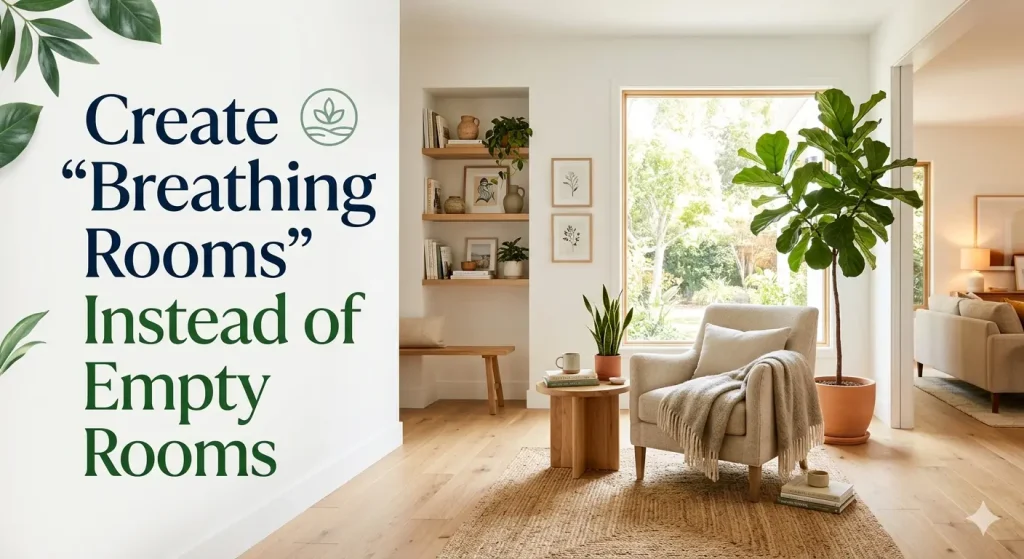
Here’s a revelation that transformed my perspective on minimalist spaces: the goal is not to render them vacant; rather, it is to create a sense of spaciousness. There is a big difference.
It can be cold, unwelcoming, and even slightly melancholy to be in an empty room. An environment with space to breathe feels quiet, purposeful, and healing. The change is small yet makes a big difference in your life.
“Breathing rooms” are based on the idea that the spaces in a room are equally as significant as the things in it. This is called “white space” in graphic design, and it’s what makes a design feel professional and clean instead of cluttered and overwhelming.
Your house operates the same way.
Rather than asking, “What can I remove?” consider asking, “Where in this room is additional open space needed?”
Let me provide you a real-life example. There used to be a bookcase, a TV stand, two end tables, a coffee table, and a storage ottoman in my living room. These all had jobs on paper. The space felt small and messy, even when it was tidy.
I didn’t have to throw away all of the furnishings. I had to give the room some space. I took out the storage ottoman and one end table. All of a sudden, there was flow. You could walk around the couch without having to move sideways. It felt like the room was twice as big, even though I just took out two things.
Here’s how to find out where your rooms need to breathe:
The Walking Test: Walk through every room in your house. Do you move across the space easily, or is it like an obstacle course? Rooms need open paths, not merely small spaces between furniture. They need real walking space that is comfortable.
The Visual Landing Test: When you walk into a room, where do your eyes instinctively go? If your eyes keep jumping from one thing to another without pausing, your room requires some breathing space. It would be best if there were vacant spaces or clear walls where your eyes and mind could rest.
The Purpose Test: It should be easy to tell what each room’s main purpose is right away. If you enter a room and cannot quickly determine its purpose due to excessive activity, it requires more space around its main function.
I used this technique in my bedroom, and it made me sleep better. I removed the chair that had become a designated spot for placing clothing (you probably have a similar one). I took down the bookshelf that was too full. I got rid of the ornamental pillows that I just threw on the floor every night.
Only the bed, two nightstands, and a basic dresser remained. But here’s the most important thing: there is now a lot of empty floor space. There is art on some of the walls, but not on all of them. There are things on the nightstands, but they aren’t too full.
I can breathe because the room can breathe.
This idea also applies to surfaces. It’s not necessary for your kitchen counter to be fully empty (unless that makes you happy). But it should have some space to breathe. You might have a coffee machine, a fruit dish, and a plant on it, but they’re all spaced out with clear counter space between them.
The secret is that giving yourself space makes everything you do feel more purposeful and important. Things look better when they have room around them instead of being crammed. Instead of just being another thing in a pile of things, your favorite vase becomes the center of attention.
Tip #3: The 90/90 Rule for Decision-Making
I got this tip from “The Minimalists,” but I changed it somewhat to make it more useful in real life. The original criteria are, “Have I used this item in the last 90 days, and will I use it in the next 90 days?” If the answer to both questions is no, it goes.
It’s a lovely beginning point, but it needs to be improved before it can be used in the real world. The 90/90 Rule with Category Exceptions and Emotional Honesty is a hidden enhancement.
Let’s start with category exceptions because the strict 90/90 rule doesn’t work very well. Things like holiday decorations, seasonal clothes, emergency supplies, and sentimental objects don’t fit neatly into 90-day timeframes. And that’s fine.
The key is to figure out your exception categories ahead of time. These are mine:
- Things that are only for a certain time of year (like clothes and decorations)
- Supplies for being ready for an emergency
- Things that have meaning to me (with certain limits I’ll explain)
- Tools that are only for hobbies I do once a year
- The 90/90 evaluation can look at whatever else I own, which is most of my stuff.
The actual secret is being honest about your feelings. This aspect is where most individuals mess up when they try to follow decluttering rules, as they often struggle to let go of items due to emotional attachments or the fear of needing them in the future.
When you pick something up and ask yourself the 90/90 questions, you’re really asking yourself, “Can I picture a situation where I might use this item?” And we can picture practically any situation because we are creative. That bread maker you haven’t used in two years? Maybe next month you’ll suddenly love artisanal sourdough. Is that exercise equipment now being used as a clothes rack? This may be the week you begin that regimen.
The part about being emotionally honest involves asking tougher questions:
- “Have I always lied to myself about using these products?” Am I maintaining this relationship based on the person I aspire to become rather than on my authentic self? Is guilt making me keep these items?
- This last question is crucial. There are many things in our homes that make us feel guilty. The exercise bike is expensive.
- The gift is from a family member whose style does not match yours. The craft supplies for projects you probably won’t ever do. You have a collection of novels that you believe you “should” read.
Here is what emotional honesty looks like in real life: I found a pasta machine in my basement last year. It was still in its packaging. It has been mine for four years. I didn’t pass the 90/90 exam because I had never used it and wasn’t going to start.
However, my initial inclination was to create justifications: “But I might want to make fresh pasta someday!” “It cost a lot!” “Getting rid of something brand new seems like a waste.”
“Have you ever made pasta by hand in the past four years?” inquired emotional honesty. No. “Do you even like pasta? “That’s OK. Is there any proof that you’ll suddenly become interested in this field? “No way.
I was holding onto an illusory version of myself as a pasta maker, someone who makes handmade fresh pasta on Sunday afternoons. That’s a lovely picture, but it’s not how things are for me. Keeping it didn’t keep the possibility alive; it made things messy and made me feel inadequate as I realized that clinging to this idealized version of myself only hindered my true passions and interests.
I gave it away. Someone who really cooks pasta was thrilled to acquire a new pasta maker at the secondhand store. It’s a win-win.
The 90/90 rule with emotional honesty helps you accept yourself as you are, not as you want to be. This acceptance oddly allows for more growth because you can focus on your strengths and areas for improvement instead of worrying about guilt and responsibility for things you don’t use.
Use this technique every three months. Every three months, set a reminder to complete a 90/90 sweep. You don’t have to look at everything in your house; simply one area or one category will do. This calm, steady practice keeps things from piling up over time without the need for huge, overwhelming decluttering activities.
Tip #4: Embrace Seasonal Rotation Systems
This is the tip that helped me keep up with simplicity for a long time. Others rarely discuss this tip.
The secret is that you don’t have to have everything available all the time.
Seasonal rotation systems let you store and move things based on the time of year, what you’re working on, or where you are in life. This lets you keep things you really use and enjoy without them all fighting for space at the same time.
I learned this technique from museums. Museums have a lot more art than they show at any one moment. They switch out collections and make new exhibits using parts from storage. This keeps the gallery area clean and lets each work shine while still keeping a broader collection.
Your house might work the same way.
This is how I do seasonal rotation:
Clothes: This is the most obvious use. In July, I don’t need to be able to get to my thick winter jackets. In January, I don’t need my summer outfits. I switch up my clothes in the spring and fall. We clean and keep our winter items in containers under the bed. It’s time to take out the summer clothes. This means that my closet is constantly half the size it would be otherwise, which makes it easy to see what I have and wear everything.
I have three sets of decorations: one for spring/summer, one for fall/winter, and one for the holidays. Only one set is out at a time. This arrangement means that my bookcases never look full, and changing the decor twice a year offers my home a new look without having to buy anything new.
Hobby Supplies: This approach changed everything. I enjoy painting, embroidering, planting, and baking, among other things. I’d need a huge craft space if I wanted to keep all of my hobby items out at the same time. Instead, I change it up dependent on what I’m into right now. When I’m in the mood to paint, I can get to my painting supplies. Embroidery is put away. I switch them when my interests change.
Kitchen Items: I have special tools for baking, barbecuing in the summer, and hosting guests during the holidays. These change with the seasons. My ordinary kitchen stays the same size all year, but I can take out specific tools when I need them.
The key to making rotation systems function is to store and classify things correctly.
I put my things in clear plastic containers with labels that say things like “Winter Clothing – Sweaters/Coats,” “Fall Décor – Living Room,” and “Baking Supplies – Specialty.” Because of this level of detail, I can discover what I need in less than a minute.
I also keep a comprehensive list of everything on a note that my girlfriend and I can both see. This sounds too structured, but it only takes about an hour to set up and saves a lot of time searching or buying duplicates by mistake since I forgot I already have something.
Here’s a crucial point: rotation systems only work if you have enough space to store things. If you find it necessary to hire a storage container for items not currently needed, it may indicate a need to reassess your storage strategy. The idea is to make the most of the space you already have, not to add more.
When I say “storage,” I mean the following:
- Storage boxes under the bed
- A shelf in the basement just for this
- The top shelves of closets are for light seasonal things.
- That’s all. If I can’t fit something in these specific rotation storage places, I probably don’t need to keep it.
The psychological benefits of changing things up with the seasons are huge. Your home feels new and different without having to buy new things all the time. You receive an occasional refresh each season when you switch things out, which makes you feel like you’re getting something new and appreciate what you already have.
Rotation also makes it easy to evaluate things. When you put away your summer decorations, you instinctively look at each one. “Should I keep this and bring it out next year, or should it go?” This regular touchpoint stops things from piling up much better than once-a-year tidying sessions.
One thing to remember: don’t use rotation as an excuse to keep things you don’t really need. “I might need this eventually” is not a good reason to keep something for nine months. Rotation is for things you use all the time, not things you might use someday.
Bringing It All Together
Minimalism doesn’t mean living in a small, uncomfortable space or going without anything. It’s about purposefully making your surroundings work for you while getting rid of things that waste your time, energy, and mental space.
These four key tips—flexible one-in-one-out, building breathing chambers, the 90/90 rule with emotional honesty, and seasonal rotation systems—work together to make a minimalist lifestyle that lasts instead of just a one-time cleanout.
The flexible one-in-one-out rule keeps things from piling up without putting too much pressure on you. Breathing chambers make your home feel tranquil and purposeful instead of empty. The 90/90 rule with emotional honesty lets you make choices based on what is real instead of what you want or feel guilty about. And seasonal rotation lets you keep things you really use without making your everyday space too full.
Begin with one piece of advice. Perhaps the one that struck a chord with you the most. Before going on to the next one, make sure you properly implement it. Minimalism is a way of life, not a goal. It’s much better to establish systems that last one at a time than to try to change everything at once.
The most significant change for me was recognizing that minimalism isn’t about having less; it’s about making room for more of what counts. Less stuff to look at implies clearer thinking. Having less stuff to take care of provides you more time to do things. People value what remains more when there are fewer distractions vying for their attention.
No one else’s home will look like yours, and that’s how it should be. It should reflect your needs, values, and identity, but without the extra stuff.
How would it feel to come home to a place that feels like it has room for you to breathe? That’s what these secrets are truly about: not minimalism as a style, but minimalism as a way to make your home really help you live your best life.
Begin small. Be kind to yourself. And please keep in mind that everything you get rid of makes way for something better, whether it’s more space in your home, clearer thinking, or just the ability to breathe easier.