The Luxury Garden Checklist
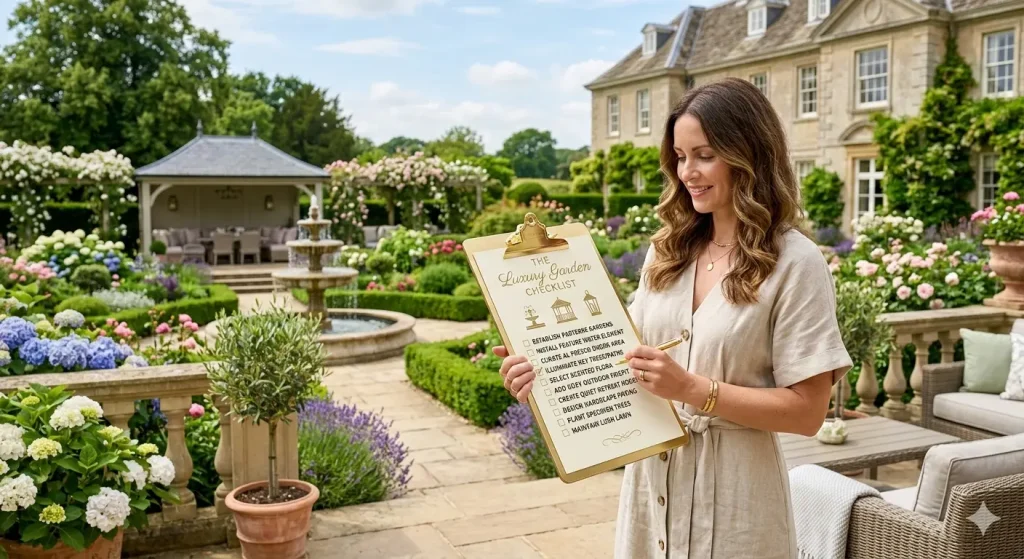
You can’t move forward in this type of garden. It doesn’t have to be the biggest or the most expensive. It doesn’t need a single beautiful flower or a bright water feature to stick in your mind. Instead, it works on a deeper level, like the way the shape, surface, and color all work together to make it beautiful. It looks lovely in January’s bright light and July’s warm sun. lets learn The Luxury Garden Checklist.
That’s what makes a garden genuinely luxurious. And contrary to what most people think, getting it is far less about money and much more about knowing three basic ideas: structure, texture, and color all year long.
No matter if the garden is on a big country estate or a little city courtyard, these three things are always the most important parts of a high-end design. If you don’t care for all of them, you’ll have to look at a flat, dead space for several months of the year, no matter how many pricey plants you’ve put in.
This guide is the final list you need. We’ll discuss each idea, how they work together, and how to make your garden great.
Part One: Structure — The Bones of a Beautiful Garden
If a luxury garden were a building, the structure would be the steel frame. The skeleton underneath provides the area form, order, and a sense of permanence. Even the most colorful planting strategy will look messy without it—a bunch of attractive items that don’t make sense, as the underlying structure is essential for creating a cohesive and harmonious design in the garden.
What We Mean by “Structure”
The permanent or semi-permanent parts of your garden that determine how the space is laid out are called the garden structure. These are
- Hardscaping includes paths, walls, patios, terraces, steps, and edging.
- Architectural plants include evergreen hedges, topiary, specimen trees, and big shrubs that keep their shape all year long.
- Built features include arbors, pergolas, raised beds, water features, and buildings for the garden.
- Sight lines and focal points are planned visual paths that lead the eye to a certain place, like a sculpture, a bench, a view, or a single beautiful tree.
- The reason structure is so important in a luxury setting is that it gives the garden a personality that doesn’t depend on the flowers being in bloom. The structure remains visible even after the last petal falls in the autumn and the perennials retreat underground. In December, a well-planned garden should still seem neat, purposeful, and lovely.
Your Structure List
1. Use strong lines to define the arrangement.
A detailed ground plan is the first step in making a luxury garden. Choose between a more formal style with straight walks, symmetrical beds, and clipped hedges or a more natural style with sweeping curves and irregular groupings. Both can look amazing, but if you mix them without a clear transition, it can be hard to tell what’s what.
Use paths and borders to make separate “rooms” or areas in the garden. Even a little place might feel like a journey as you move from one location to another. Imagine a shaded seating area that opens out to a sunny herbaceous border, or a gravel courtyard that goes through an archway into a wilder meadow-style planting.
2. Buy good-quality hardscaping materials.
This is one area where the budget really does matter. Over time, natural stone, handcrafted brick, aged oak, and weathered steel all get better and more fascinating. Cheap concrete pavers and plastic edging accomplish the reverse. It is better to utilize a modest amount of high-quality material than to cover a huge area with something of lower quality if you don’t have a lot of money. One path made of recycled York stone will make your landscape seem better than an acre of poured concrete.
3. Set up a framework of evergreens.
Evergreen plants are the most crucial thing you can get for a luxury landscape. They give structure all year round. Think about: - Yew (Taxus baccata): The best plant for hedges and topiary. It is thick, black, and highly responsive to pruning. It forms the foundation of many of the world’s best gardens.
- Box (Buxus sempervirens): Great for low hedges, parterre patterns, and small topiary. If box blight is a problem where you live, you might want to look at other options like Ilex crenata or Pittosporum.
- Holly (Ilex) is ideal for taller hedges, screens, and specimen plants. The shiny leaves look wonderful in the winter light.
- The Portuguese laurel (Prunus lusitanica) is a more elegant choice than the typical cherry laurel. It has darker leaves and a more polished shape.
- Niwaki-style cloud trimming, which comes from Japanese garden tradition, turns regular evergreens into living sculptures. This method works effectively on trees like Pinus sylvestris, Taxus, and Osmanthus.
4. Have at least one tree that is a specimen.
A specimen tree serves as a prominent feature in the landscape. It holds the whole piece together and provides the eye a place to rest. For high-end gardens, think of trees that are captivating all year round:
- The bark of the Acer griseum (paperbark maple) is cinnamon-colored and peels off. In the fall, the tree turns bright red.
Cornus kousa has beautiful, tiered branches, white summer bracts, and red fall leaves. - Betula utilis var. jacquemontii (Himalayan birch): The bark is a bright white that glows in the winter light.
- Magnolia: In the spring, the blossoms are very dramatic on bare branches, and the tree has a beautiful shape all year long.
- Multi-stem trees, like Amelanchier, birch, or hornbeam, have more than one trunk. These trees give an instant sense of age and sculptural interest.
5. Put in a built-in focus point.
A strategically placed garden structure can serve as both a destination and a design anchor. This may be a modest stone bench at the end of a path, a modern steel water blade, a handmade oak pergola, or a garden pavilion with classic proportions. The idea is to hold back: one or two properly picked focus points will always look better than a yard full of decorations that are all trying to get your attention.
Part Two: Texture — The Element That Separates Good from Extraordinary
People often forget about texture when designing a garden, yet it is probably the most important thing that affects how a room feels. Even a novice would see the difference between two gardens with the same plants and layout if one paid attention to texture and the other didn’t.
What “Texture” Means
In landscape design, texture is how surfaces look and feel, whether they are plants or not. It includes:
- The size, shape, and surface of the leaves: glossy or matte, broad or fine, smooth or hairy or felted.
- Plant habit and density: airy and see-through versus thick and substantial; upright versus spreading.
- Bark, stems, and seed heads can exhibit peeling, cracking, smoothness, color, or architectural characteristics.
- Finishes for tough surfaces: rough-hewn stone vs. polished stone, gravel vs. smooth paving, and rusty steel vs. brushed stainless.
- Water: still and reflective vs. moving and textured.
Contrast is what makes texture magical. A wide, shiny hosta leaf seems even more spectacular when it is next to the fluffy fronds of a fern. A pool of smooth, reflective water looks even better when it is surrounded by rough, natural stone. Everything becomes a single mass without contrast. With it, everything stands out more and is easier to read.
Your Texture List
1. On purpose, mix fine and coarse foliage.
Make planned pairings that put leaves with varied scales next to each other. For instance:
- Put the big, paddle-shaped leaves of Tetrapanax papyrifer (rice paper plant) next to the thin, threadlike leaves of ornamental grasses like Stipa tenuissima.
- As ground cover, mix the big, architectural fronds of tree ferns (Dicksonia antarctica) with the little, detailed leaves of Soleirolia soleirolii (mind-your-own-business).
- Hosta ‘Sum and Substance’ has big, ribbed leaves that go well with the fine, dissected leaves of Japanese maples (Acer palmatum var. dissectum).
The idea is simple: putting huge things next to small things makes drama. Putting comparable items next to each other makes things boring.
2. Use ornamental grasses as workhorses for texture.
Ornamental grasses are the best at adding texture to a garden. They add movement, openness, and a lightness that no broadleaf plant can match. Important plants for high-end gardens are:
- Tall, arching types of Miscanthus sinensis have fluffy plumes that last into the winter. ‘Malepartus,’ ‘Morning Light,’ and ‘Flamingo’ are all excellent types of plants.
- Golden oats (Stipa gigantea) is a see-through grass with long, shiny flower stems that catch the sun like spun gold. It serves as an excellent choice for creating a clear screen or a focal point of interest.
- Calamagrostis x acutiflora ‘Karl Foerster’ is a tall, slender grass that grows in a columnar shape. It is an excellent choice for establishing a vertical rhythm within a border.
- Hakonechloa macra is an elegant, cascading grass that works well in shady areas and containers and to soften the edges of walkways and steps.
- Molinia caerulea subsp. arundinacea, ‘Transparent,’ is a grass with tall, airy flower stems that make it look like a veil.
3. Don’t only think about leaves; think about bark, stems, and seed heads as well.
In the winter, a luxury garden depends a lot on textures that aren’t leaves. Make plans for:
- Bark interest: The peeling bark of Acer griseum, the glossy mahogany stems of Prunus serrula, the ghostly white trunks of birch, and the deeply fissured bark of mature oaks.
- The stems of Cornus (dogwood) plants like ‘Midwinter Fire’ and Cornus alba ‘Sibirica’ are bright orange, red, and yellow in the winter. The stems of Rubus cockburnianus are bleached and shine in dim winter light.
- Persistent seed heads: Many perennials, like Echinacea, Sedum, Phlomis, Eryngium, and Rudbeckia, make seed heads that stay in shape far into winter, especially when frost hits them.
4. Arrange textures in vertical layers.
A planting system that is really rich has layers that go from the ground to the top of the trees. Think about:
- Ground layer: moss, gravel, low-growing plants, or ground cover. Thymus, Erigeron karvinskianus, and Sagina subulata are some of the plants that do well in this area.
- The herbaceous layer is made up of mid-height perennials and grasses that make up most of the planting. This is your chance to have the most variety in textures.
- Shrub layer: Evergreen and deciduous bushes that make the area bigger, denser, and taller. Combine shrubs with shiny leaves, like Choisya or Sarcococca, with those with matte, felted leaves, like Ballota or Phlomis.
- The canopy layer is made up of trees and tall structural plants that make up the above structure, offer dappled shade, and give the feeling of being enclosed.
5. Add texture to rough surfaces.
Don’t forget about the things that aren’t alive. A gravel walkway next to smooth stone setts creates a contrast between rough and smooth textures. A modern garden might use polished basalt paving and rough Corten steel planters together. A cottage-style garden might combine old bricks and soft, creeping vines that flow over the edges to make the line between hard and soft less clear.
The same goes for garden furniture, pots, and other items. Instead of smooth, featureless plastic, choose materials that have interesting surfaces, such as hand-thrown terracotta, patinated bronze, or brushed teak.
Part Three: Year-Round Color — The Art of the Continuous Garden
Color is the most evident part of a beautiful garden, and it’s also the part that most gardeners naturally pay the most attention to. But when you’re trying to live in luxury, you don’t just want color; you want color that is thought out and changes beautifully from month to month without ever making the landscape look bare or spent.
This calls for a completely new way of doing things than the usual “plant it and hope” method. It takes planning, self-control, and the ability to think beyond the obvious summer display, such as incorporating seasonal plants that provide visual interest and color throughout the year.
The Seasonal Color Framework
Winter (December to February)
Winter is when luxury gardens stand out the most from regular ones. Most gardens are dead and boring; however, a well-planned luxury garden has
- The leaves are always green, with colors ranging from the almost black of yew to the bright chartreuse of Choisya ternata ‘Sundance.’
- Plants that bloom in the winter: Hamamelis (witch hazel) has fragrant, spidery flowers that come in yellow, orange, and red. From December to March, hellebores bloom with beautiful, drooping flowers. The sweet box, or Sarcococca, makes the winter garden smell so sweet that it’s hard to believe. Galanthus (snowdrops) cover the ground under trees that lose their leaves.
- Bark and stem color: These are the main sources of color in the winter, as we talked about in the texture section. The crimson stems of Cornus, the white bark of birch, and the amber tones of peeling Acer griseum bark all add to the rich winter palette.
- Structural seed heads: Dried seed heads of grasses and perennials that are left standing through the fall and winter give off tawny gold and bronze tones. When the low winter sun shines through them or when frost rims them, they look especially lovely.
March–May is spring.
Spring is the time of year when people look forward to new things. The luxurious spring garden methodically adds color, starting with the first bulbs and ending with the lushness of late May.
- In early spring, crocus, daffodil, muscari, and scilla grew naturally under trees and in grassy regions. Prunus and Malus bloom in the air. Brunnera, Pulmonaria, and Primula fill up the gloomy edges.
- In the middle of spring, tulips should be planted in large groups of the same kind for the best effect, not in random groups.
- Narcissus that blooms late. Forget-me-nots as ground cover. Wisteria and Clematis montana are starting to show up on walls and pergolas.
- Late spring: Alliums fill the space between spring bulbs and summer perennials. Iris germanica. Peonies are starting to bloom. New leaves are growing on deciduous trees in colors ranging from lime green to golden.
June to August: Summer
In the summer, there are many things to do, and the fancy way to do it is not to use as many colors as possible but to make a color palette that works together. Instead of many clashing colors, the most elegant summer gardens usually use a small number of colors, like delicate pinks, mauves, and silvers, or whites, greens, and pale yellows.
Some of the most important summer performers are
- Roses are the most luxurious plants for the landscape. Pick types that smell powerful, bloom more than once, and are resistant to illness. Many people enjoy David Austin English roses, but species and ancient shrub roses also contribute significantly to the overall character. Roses that climb on walls, pergolas, and obelisks provide color to the vertical space.
- Salvia, Geranium, Nepeta, Perovskia, Verbena bonariensis, Astrantia, Phlox, Achillea, Hemerocallis, and Agapanthus are all dependable and beautiful herbaceous perennials.
- Cosmos, dahlias (which are actually fragile perennials), nicotiana, ammi majus, and sweet peas grown on supports can fill in gaps and make the season last longer.
- Climbers like jasmine, honeysuckle, and late-flowering clematis add color and scent to walls and buildings.
Fall (September to November)
Fall is often the least planned season, but it has some of the year’s brightest colors. The luxurious garden welcomes fall instead of being sad about the end of summer.
- The best thing about fall is the color of the leaves. Japanese maples, Liquidambar, Cercidiphyllum, Amelanchier, and Parrotia persica all have beautiful leaf colors. Ornamental grasses change color to gold, amber, and rust.
- Asters, Anemone x hybrida (Japanese anemones), Rudbeckia, Sedum spectabile, Persicaria, and Tricyrtis are all late-flowering perennials that bloom far into October and beyond.
- Malus (crab apples), Sorbus, Callicarpa, Pyracantha, and Rosa (rose hips) all provide bright berry and fruit displays that also feed animals.
- Miscanthus, Panicum, and Pennisetum grasses are at their best in the fall, when their airy plumes catch the softer light.
A List of Colors for Every Season
1. Check your garden every month.
Take a stroll through your garden or your layout and ask yourself, “What is adding color and interest right now?” Do this every month of the year. Find the holes. Most gardens have a lot of color from May to July and very little from November to February. The best thing you can do to make things better is to deal with those lean months by incorporating plants that provide winter interest, such as evergreens and plants with colorful bark or berries.
2. Don’t only plant flowers; be sure to add foliage color as well.
Flowers don’t last long. Leaves stay on for months. Put plants with exceptional leaf colors at the top of your list:
- Gold and chartreuse: Aureola, Choisya ternata ‘Sundance,’ and Philadelphus coronarius ‘Aureus.’
- Artemisia, Stachys byzantina, Convolvulus cneorum, and Elaeagnus ‘Quicksilver’ are silver and gray.
- Heuchera “Palace Purple,” Cotinus coggygria “Royal Purple,” Sambucus nigra “Black Lace,” and Acer palmatum “Bloodgood” are all purple and bronze.
- Variegated: Use it carefully and only a little bit. One well-placed variegated Cornus alternifolia ‘Argentea’ can look amazing. A border with ten different variegated plants will look like a quilt.
3. Stick to a strict color scheme.
Luxury is all about self-control. Pick two or three main colors and use them in the planting every year. Use accent colors sparingly for punctuation. A landscape with delicate blues, purples, and whites, with dark magenta accents here and there, is much more elegant than one with a haphazard mix of all the colors from the garden center.
4. Plant in groups of three or four, not one or two.
Plants that are spaced out along a border make it look patchy and disjointed. Luxury planting plans use big groups of plants, usually three, five, seven, or more, and repeat important plants at regular intervals along the border to generate a rhythm and a sense of unity. Designers like Gertrude Jekyll and Piet Oudolf have used this approach for a long time. It’s one of the simplest ways to create a garden that exudes expert craftsmanship.
5. Don’t forget that scent is a color you can’t see.
The scent is the hidden part of luxury. Daphne and Sarcococca in the winter, hyacinths and Viburnum in the spring, roses and lavender in the summer, and Clematis rehderiana and late-flowering honeysuckle in the fall are all good choices for scents. Put fragrant plants near doorways, dining places, and walks where people will see them often.
Bringing It All Together: The Integrated Approach
The fundamental secret of a luxury garden is that structure, texture, and color function together as a system. Every planting decision should be reviewed simultaneously using all three glasses.
When selecting a plant, ask:
Structure: What shape does it contribute? Does it increase height, width, or density? Does it maintain its shape through the winter?
Texture: What is the foliage character? How does it compare to its neighbors? Is there anything fascinating about the bark, stem, or seed heads?
Color: When does it add color? What kind of color? Is it compatible with the existing palette? Does it bridge a seasonal gap?
A plant that meets all three criteria, such as a Cornus kousa with its tiered structure, intriguing bark texture, and multi-season color from flowers, foliage, and fruit, is worth ten times more in a design than a plant that only blooms for two weeks in June.
A summary of the final checklist structure
- The final checklist structure should include an effective spatial layout that features distinct zones and sight lines.
- High-quality hardscape materials.
- Evergreen framework: hedges, topiary, and structural shrubs.
- Include at least one tree specimen and one or two focus points.
Texture:
- There should be a deliberate contrast between the delicate and coarse foliage.
- Ornamental grasses promote movement and transparency.
- Winter interest in bark, stems, and seed heads
- The grasses create a vertical layer that extends from the ground cover to the canopy.
- Hard surfaces and materials exhibit a variation in texture.
Year-round Color:
- Monthly audit with no lapse for more than two weeks.
- Use foliage as the base and flowers as the highlight.
- Maintain a consistent color palette.
- Extensive grouping and rhythmic repetition.
- Seasonal fragrances.
A Final Thought
The world’s most beautiful gardens have one thing in common: their size, location, and owners’ wealth don’t matter. It seems like every plant, road, and stone was always supposed to be where it is.
You don’t just feel that way. Someone took the time to consider structure before planting, texture before flowers, and January before June.
A luxury garden is not just a place to keep expensive stuff. It is a composition, a planned and changing work of art that is worth looking at from every aspect and in every season. This checklist is the first step in your plan. The true magic begins with the small details, the joyful occurrences, and the way your piece of land reacts to your vision.
Start with the bones. Add the texture in layers. Weave the color into every month. Then, step back and watch the garden grow into something more beautiful than you thought.