4 Pro Tips for Custom Housing Plans
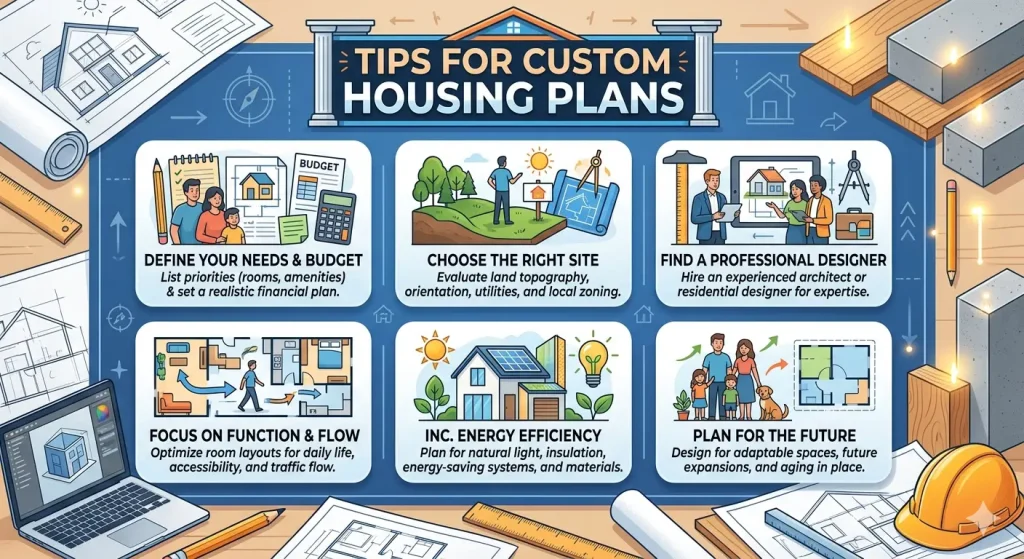
Everything you need to know before you start drawing, from budgeting and design strategy to getting the right permits and making sure your investment will last.
Building your own home is one of the most fun and difficult things you’ll ever do. When you buy a pre-built home, you get what you see. But with a bespoke housing plan, you get to choose what you want. You decide where every wall, window, hallway, and electrical outlet goes. But with that independence comes a lot of responsibility, decision-making, and possible problems that could stop your project if you’re not ready, such as miscalculating costs, underestimating time requirements, or failing to comply with local building regulations.
The planning stage often determines whether a bespoke home becomes a reality or a story of cost overruns, design regrets, and building delays. Everything, including your budget, schedule, everyday life, and the long-term value of your home, will be determined by the plans you accept before any work begins.
This post will provide you four professional-level ideas that architects, builders, and experienced homeowners swear by, whether you’re building your first custom house or trying to improve on a previous experience. These aren’t just surface-level tips. These are the big-picture, detail-oriented ideas that set apart amateur blueprints from professionally built bespoke homes.
Let’s get started.
Pro Tip #1: Design for How You Actually Live—Not How You Think You Should Live
This is the most important advice from any architect or custom house designer, but it’s often ignored. People often plan a bespoke home based on an idealized image of their life instead of how they actually live their lives.
The “Magazine Home” Trap
We’ve all looked at pictures of beautiful open-concept kitchens, dramatic two-story foyers, and large master suites in architectural magazines or on Pinterest boards. These pictures are powerful and can have a big impact on the choices you make about design. But those pictures don’t show you the family of four who never uses their formal dining room, the couple who built a huge gourmet kitchen but eats takeout five nights a week, or the homeowner who spent a lot of money on a beautiful open floor plan only to find out that the noise from the kitchen goes straight into the living room during every phone call and TV show.
When making custom dwelling plans, you should be honest with yourself. Before you draw a room, take two to three weeks to really think about how you use your current home. Make notes. Where do you spend most of your time? Where do you feel like you don’t have enough room? Which rooms do you stay away from? Where does clutter tend to build up? What daily tasks do you consider frustrating because of the way your home is set up?
The Audit of Lifestyle
Before they start designing, many professional designers do what is known as a “lifestyle audit.” You can do this audit on your own with a few basic tasks:
Daily Flow Mapping: Picture what a normal weekday morning looks like in your head. You get up, go to the restroom, then the kitchen to make breakfast. After that, you prepare the children for school, collect your keys, and proceed to the garage. Now draw a similar flow on your proposed floor plan. How many halls do you cross? How many doors do you open? Are there places where two family members would run into each other during the morning rush? A bespoke home that is well-designed keeps you from moving about too much and makes it simple to navigate between the rooms you use the most.
Activity Zoning: Organize your daily tasks into groups: quiet activities (reading, working from home, sleeping), social activities (entertaining, family movie nights, cooking together), utility activities (laundry, storage, cleaning), and transition activities (entering the home, moving between floors). Your floor layout should make it easy to see where each category starts and ends, with enough space between them. Putting a home office right next to a playroom is a sure way to get frustrated. If the laundry room is far from the bedrooms, you’ll have to make extra trips daily.
Future-State Planning: Think about how your life will evolve in the next 10 to 15 years. Will your kids leave when they grow up? Are your aging parents going to move in? Will you start working from home? Will your interests change? The best custom housing ideas take into account both your current life and the life you want to live in the future.
Intentionality in Each Room
Every room in your bespoke plan should pass the “why” test. What is the purpose of this room? Who is going to use it? How often? What are they going to do in it? If you find it challenging to clearly answer these questions, it may be worthwhile to reconsider that space.
Formal dining rooms and living rooms are two typical examples. These were common features in custom home plans from the 1990s to the early 2000s. Many homeowners say that these rooms are unoccupied 360 days a year. That’s thousands of square feet and tens of thousands of dollars for space that doesn’t accomplish much for you every day.
Consider rooms that serve multiple purposes instead. A flex room in the main living area can be a playroom for kids, a study place for teens, a home office for adults, and a hobby room for retirees. One room, four stages of life, no wasted space.
Pro Tip #2: Build Your Budget from the Inside Out—And Protect It Ruthlessly
The most important creative advice is to design for real life, and the most important practical tip is to know how to manage your money. Custom house projects often exceed their budget due to avoidable factors. The most important thing is to know how the costs of building a custom home really work and to make a budget that takes those expenses into account instead of hoping for the best.
Getting to know the real cost structure
The biggest error that most people make when building their first custom home is to only look at the cost per square foot. A builder can tell you that a home costs $175 per square foot. If your home is 2,500 square feet, you might estimate your budget is $437,500. No, it’s not. That number usually includes the fundamental building work, like framing, roofing, standard finishes, and basic plumbing and electrical work. It doesn’t usually include:
- Buying land and getting it ready (clearing, grading, and testing the soil)
- Fees for architects and engineers (usually 8% to 15% of the cost of building)
- Fees for permits and impacts, which vary a lot from town to town
- Connections to utilities such as water, sewer, electricity, gas, and the internet
- Landscaping and hardscaping include planting, driveways, walkways, retaining walls, and more.
- Things that go into interior design include window coverings, built-in bookshelves, and custom closets.
- Appliances and fittings, especially if you choose high-end ones
Furniture and decorations (your current furniture could not fit or look good in the new area) - Emergency finances (the money that every project needs to have on hand)
When you add these things together, the real cost of a custom home is usually 25% to 40% more than the original construction quotation. The biggest reason custom home projects go over budget is that they don’t take this gap into account.
The 15% Rule for Contingencies
Every competent builder and financial advisor will tell you the same thing: put aside at least 15% of your overall project budget for unexpected costs. Not 5%. Not ten percent. At least fifteen percent.
This is because bespoke homes are, by definition, unique ventures. Your home is being built for the first time, while production homes have the same floor plan created hundreds of times. Things will go wrong that you didn’t expect. The soil test can show that the ground needs deeper foundations. Your choice of roofing material can be on backorder, which could mean a more expensive option or a long wait. The electrician might find that your lighting scheme needs a new electrical panel. To fulfill new building requirements, the city may need to do more inspections or make changes.
These aren’t evidence that the builder didn’t plan well or wasn’t good at their job. They’re just a typical part of building something custom. Your emergency fund lets you deal with these surprises without hurting the condition of your home or going into debt.
The Matrix of Priorities
Make a priority matrix that puts everything in your home into three groups before you set your budget.
Tier 1—Non-Negotiables: These are the things that make you want to construct custom in the first place. It might be the chef’s kitchen with appliances that are up to professional standards. Maybe it’s the building envelope that saves energy and will cut your utility bills for decades. Maybe it’s the easy-to-use design elements that make it possible to age in place. Regardless of their nature, these are the primary funding priorities that remain unaffected by budget cuts.
Tier 2: Strong Preferences—These are things you really want but could change if you need to. You might prefer hardwood flooring in every room of the house, but you could be okay with hardwood in the main living areas and high-end luxury vinyl in the bedrooms. You could desire a garage for three cars, but if money is short, two cars might be OK.
Tier 3: Wish List: These are the “nice to have” things, including the outdoor kitchen, the built-in surround sound system, and the heated bathroom floors. These will receive funding only after Tiers 1 and 2 are fully funded and the contingency fund is properly set up.
This matrix gives you a straightforward way to make decisions when you have to deal with budget problems. You don’t make cuts in a hurry based on how you feel. Instead, you carefully cut from Tier 3, then Tier 2 if you have to, and never touch Tier 1.
Put money where it matters.
Custom house builders who have been in the business for a long time always point to key areas where spending more up front pays off for years or even decades:
Insulation and building envelope: Once the walls close up, you hardly notice the insulation, high-performance windows, and effective air sealing. But they affect your comfort and energy costs every day for the life of the home.
Plumbing and electrical infrastructure: Adding more conduit, putting in a bigger electrical panel, and roughing in plumbing for a possible future bathroom are all far cheaper to do during construction than after. You may think of it as a buying option for your home’s future.
Don’t skimp on the foundation and structural parts. Ever. Fixing the foundation is one of the most expensive and disruptive things a homeowner can do.
Pro Tip #3: Master the Art of Working with Your Design and Build Team
A group of specialists, including architects, designers, builders, engineers, and specialty contractors, will bring your unique house to life. The quality, cost, and timeframe of your project all depend on how well you work with this team. It’s not simply about recruiting the proper people (though that’s vital). It’s about knowing how to talk to people, make choices, and keep positive relationships across a process that can last anywhere from 12 to 24 months.
Picking the Right Builder and Architect
Choosing your architect and builder is perhaps the most important choice you’ll make except for the design itself. The relationship between these two professionals is just as crucial as your bond with each of them. They will affect every part of your encounter.
Architects have a vision for how things should look, know how to solve spatial problems, and grasp the technical details of building codes and structural needs. The greatest home architects don’t just make beautiful ideas. They really listen to you, question your preconceptions in a helpful way, and turn your lifestyle needs into useful spaces.
Builders know how to build things, have connections with trade contractors, know about materials, and they know how to manage projects. The finest builders are open and honest with their clients, point out possible problems before they happen, offer solutions instead of just problems, and take pride in their work.
Don’t only look at portfolios and pricing quotes when you hire these people. When you talk to them, act like you’re recruiting a long-term business partner, because that’s what you’re doing. Find out how they like to talk to people. How often will they keep you up-to-date? How do they deal with conflicts? What do they do when problems arise that they didn’t expect? Could you interview three to five recent clients, including those from projects that didn’t go as planned? You may learn a lot more about a professional based on how they deal with problems than based on how they deal with success.
The Communication Framework
Miscommunication is the silent demise of custom home projects. You, your architect, and your builder all have different ideas about what “I want a spacious kitchen” implies. Depending on who is interpreting it, “spacious” could mean 150 square feet or 400 square feet.
Set up a way to talk to each other from the start:
Weekly Progress Meetings: Set up a regular weekly meeting with your builder (and architect during the design process) on the same day and at the same time each week. Before the meeting, both sides should add to a shared agenda document. This ensures you don’t overlook anything and provides ample time for everyone to consider their responses.
Deadlines for Decisions: Make a master decision schedule that shows when you need to make each important choice. For example, you need to choose flooring by week 8, lighting fixtures by week 12, and cabinet hardware by week 16. One of the most typical reasons for construction delays is making choices too late. If a decision isn’t made on time, the builder needs to either cease working on that part of the project (which messes up the timeline) or make a temporary choice that may need to be redone later (which raises costs).
Visual Communication: Use pictures, samples, and other physical references to talk to people instead of only words wherever you can. Instead of saying, “I want a warm gray paint color,” bring three paint chips and point to the one you like best. Instead of talking about what you want in a kitchen island, present pictures of five islands you adore and tell them what you like about each one.
Change Order Protocol: Before work starts, everyone should agree on a defined method for change orders. Before work begins, every change, no matter how tiny, should be written down along with its effect on the cost and the timetable. It’s not about not trusting someone; it’s about being clear. Written agreements, not verbal pledges, are what make the best builder-client partnerships.
Plan for Decision Fatigue to Happen.
You have to make thousands of choices when you build a bespoke home. A lot. You have to make a lot of choices, from big ones like the layout of your house to little ones like the finish on your bathroom drawer knobs. Most homeowners get really tired of making decisions by the third or fourth month. This is a mental state when the quality of your choices goes down because you’ve made so many of them.
To fight this, make the most crucial decisions at the beginning of the project, when your energy and excitement are at their peak. Instead of making decisions one at a time, group related ones together (such as choosing all the flooring in one session and all the lighting in another). Don’t be hesitant to let your designer or builder make judgments that aren’t as important. Just give them clear guidelines, such as “Pick a grout color that goes well with this tile. “I trust your judgment.”
Pro Tip #4: Future-Proof Your Home with Smart Infrastructure and Flexible Design
The fourth and last suggestion for builders of custom homes is about the future, which is something most builders don’t think about until it’s too late. Your custom house isn’t merely a representation of who you are now. It should be a beneficial investment for many years to come, and it should keep its worth even when the market changes. When you future-proof your home plans, you don’t try to guess what will happen in the future. Instead, you make sure that your plans can change to fit whatever happens, such as incorporating adaptable technology that can be upgraded or replaced as new innovations emerge.
Infrastructure for Technology
Technology changes quickly, and the smart home features that look new and cool today might not be useful in five years. Instead of spending a lot of money on smart home technologies that might not last, put money into the infrastructure that will support any new technology that comes along:
Conduit and Cable Pathways: Put empty conduit (plastic or metal tubes) through the walls of your house from the attic to the basement and to every room. This lets you run new cables for networking, audio, security, or technologies that don’t exist yet without having to open up walls.
Strong Electrical Capacity: Put in an electrical panel that is bigger than what you need right now. It seems like a lot of power now, but in the next ten years, when you add a hot tub, a home server, an electric vehicle charger, and a workshop, you’ll be glad you have it.
Structured Wiring Hub: Choose a central closet or utility space in your home to be the technology hub. Even if you plan to use Wi-Fi, run Cat6A Ethernet wire (or better) to every room. Hardwired connections will always be faster and more dependable than wireless ones. They are also the basis for future smart home systems.
Install USB and smart outlets around the house. These outlets have USB ports and wiring that works with smart switches. The extra cost during building is small, but retrofitting later is costly and troublesome, making it necessary to plan for these installations during the initial construction phase to avoid future expenses and complications.
Universal Design and Living in Place
Adding universal design ideas to your custom housing plan is one of the best things you can do, regardless of your age or fitness level. Universal design creates accessible, comfortable spaces for all ages and abilities without sacrificing aesthetics.
Zero-Step Entry: Make sure that at least one door to your home has no steps. This feature is useful for everyone, from parents with strollers to older people who come to see you when you’re lugging heavy groceries. If you ever sell the house, it also greatly increases the number of people who might buy it.
Wider Hallways and Doorways: The average width of an interior door is 30 inches. During the framing stage, it costs nearly nothing to make them 36 inches taller, but the added height makes a big difference in how easy they are to get to. In the same way, 42-inch hallways feel bigger and can hold mobility equipment if they are ever needed.
Main-Floor Living Capability: Even if you plan to utilize the second floor every day, make sure the main floor has everything you need to live there, like a bedroom, a full bathroom, a kitchen, and a living room. If you have trouble moving around later in life because of an injury, surgery, or old age, you won’t have to sell your property or do a big makeover.
Blocking in Bathroom Walls: In all bathrooms, especially in the shower and next to the toilet, use substantial wood blocking behind the drywall. This means that grab bars can be safely put up later without having to open up walls and look for studs. The cost of building it is really low—just a few dollars for wood—but the value is huge.
Lever-Style Hardware: Instead of circular knobs, use lever-style door handles and faucets. They are simpler for folks with arthritis, weak grip, or full hands to use, and they look just as appealing.
Sustainability and energy efficiency
Energy standards are getting stricter all around the country, and energy prices are increasing with time. Building beyond the present minimal energy code requirements isn’t just good for the environment; it’s also good for your wallet, as it can lead to significant long-term savings on energy bills and increase the overall value of your property.
Solar-Ready Design: Even if you don’t put up solar panels right away, make sure your roof is ready for them. This entails making sure that the roof planes face south (in the Northern Hemisphere), using a roof pitch that collects the most solar energy for your latitude, and wiring conduit from the roof to the electrical panel. Building your home solar-ready doesn’t incur significant costs, but it can save you thousands if you decide to install panels later.
High-Performance HVAC: Get a heating and cooling system that is the proper size and works well. “Right-sized” is crucial since a system that is too big turns on and off too often, wasting energy and making the temperature change too much. Ask your HVAC contractor to complete a Manual J load calculation based on your exact floor plan, insulation levels, and window specs.
Water Conservation: Use high-efficiency fixtures, think about a hot water recirculation system (which saves thousands of gallons of water each year and cuts down on the time it takes to get hot water), and plan your landscape such that it needs less water. In many places, the cost of water is going up faster than the cost of energy. This trend makes saving water smart for both the environment and your wallet.
Spaces that are flexible
The pandemic showed us all how quickly and severely life can change. Houses that adapt to changing times hold greater personal and financial value than those with fixed layouts.
Consider making at least one or two rooms in your home that are flexible on purpose. Depending on your life stage, an extra room above the garage can be a guest suite, a rental unit, a home gym, or a place for teens to hang out. If you establish a catering business or hold big family gatherings, a big pantry with plumbing can serve as a second prep kitchen. If you remodel your basement and add a separate entrance, you can rent it out or use it as an in-law apartment.
The most important thing is to put in the plumbing rough-ins, electrical capacity, structural stability, and distinct HVAC zones during the first construction. You can finish and furnish the space whenever necessary.
Bringing It All Together
Building a custom home is a long process, not a short one. Your housing plans come together during the planning phase, which truly determines the outcome. Let’s go over the four pieces of expert advice that will help your project succeed:
Design for the way you really live. Do an honest audit of your lifestyle, plan out your daily routines, make activity zones, and make sure every room passes the “why” test. Don’t give in to the need to create for a life that isn’t real.
Make your budget from the inside out and guard it with all your might. Know how much custom building will really cost, keep a 15% emergency fund, make a priority matrix for your features, and put a lot of money into the hidden infrastructure that will give you long-term value.
Learn how to work well with your design and build team. Don’t simply look at portfolios when choosing professionals; look at their ability to communicate and solve problems as well. Set up clear communication, stick to deadlines, and prepare for decision fatigue during the project.
Use smart infrastructure and flexible design to make your home last. Put money on technological conduits and capacity, use universal design principles, go above and beyond existing energy efficiency guidelines, and make sure your spaces can change as life does.
Your custom home should be more than just a lovely building. It should be a place where you may live and work that supports your everyday life, changes with your needs, keeps your money safe, and makes you happy every day. The time you put into careful, long-term planning will pay off for years to come.
Don’t rush the plans. Ask tough questions. Question what you think you know. Don’t forget the little things. The magic isn’t in the building itself when you create a bespoke home; it’s in the planning that comes before it.