Small Rooms Big Impact Scale and Walkways
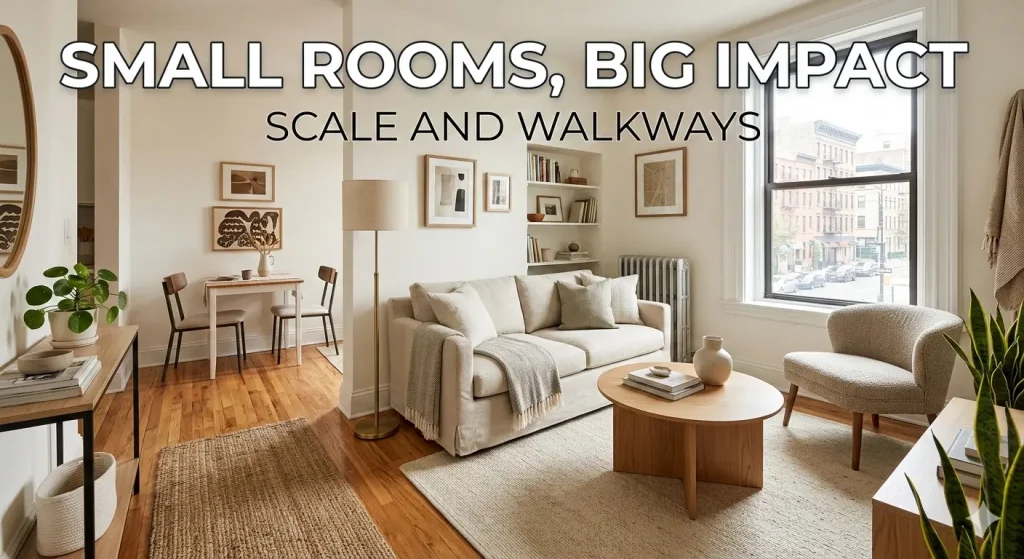
This article explores how to transform tight spaces into rooms that truly breathe, move, and inspire.
Most of us are familiar with a particular time in our lives. You are in a room. It may be the studio apartment you just signed a lease on, the small spare bedroom in your first house, or even the narrow hallway that leads from your kitchen to your living room. You look around, and it feels like the walls are closing in on you. Everything appears cramped, disorganized, and uncomfortably close. You think to yourself, “There’s no way the arrangement will work.”
But here’s the fact that no one tells you soon enough: small rooms are fine. The way we think about small spaces is the problem.
Some of the most beautiful, unforgettable, and profoundly moving places in the world are small. Imagine a little Japanese tea parlor that is just big enough for four people to sit in. Imagine a well-organized Parisian studio with a café table near the window. Think of that one friend’s apartment, the one that somehow feels twice as big as it really is. Everything just works there.
There is no magic that makes those environments operate. It’s a grasp of two basic design ideas: scale and paths.
At first, these two ideas may sound complicated or scary, but if you start paying attention, they make perfect sense. And once you understand them, you’ll never see a small room the same way again.
Why we should respect small rooms more
Let’s talk about the why before we go into the how. In a culture that tends to think that more is better, little rooms acquire a bad name. Large homes with open floor plans and spacious living spaces have been the ideal for many years. It’s fine to love a big room, but a well-designed tiny space may be really powerful.
Small rooms let people feel close to each other. They bring people together, both physically and emotionally. A dinner party in a small, cozy dining room frequently leads to more meaningful conversations than one in a big, echoing hall. When done well, a small reading nook becomes a personal retreat that a big living room can’t match.
Small rooms also make you think about what you’re doing. Every choice is more important when you don’t have a lot of space to fill. The chair you choose, the height of your shelves, and the route someone takes to go from the entryway to the couch are all important choices. That’s what makes it so rewarding to design a little place. There is no waste. There is no afterthought.
The most important thing is to learn how to work with the space instead of against it. And that starts with knowing what a scale is.
Scale: The Hidden Power That Changes the Mood of a Room
People commonly mix up the word “scale” with “size” when talking about design. But they are not the same. A couch is 84 inches long, and a coffee table is 18 inches tall. Size is objective. On the other side, scale is about relationships. It’s about how things are connected to each other and to the space they take up.
You can feel whether a room is too big or too little before you can say what it is. That huge sectional couch fits in a living room that is only 10 by 12 feet? You feel cramped, but it’s not the room’s size; the furniture is too big. On the other hand, a room with a lot of little, fragile things strewn about can feel broken up and messy, as if nothing fits together.
Finding the proper scale in a tiny room means finding the right balance between the furniture, the decor, and the architecture so that they all look like they belong together.
Picking the Right Scale for Your Furniture
The most common error individuals make when they have small rooms is to use small furnishings. It makes sense: tiny room, small furnishings, right? But that instinct doesn’t always work. A room full of tiny things can seem fussy, messy, and much smaller than it is, which is amusing.
Instead, think about this: pick a few well-sized pieces instead of many small ones. One well-proportioned, comfy armchair may hold a room together much better than three skinny chairs fighting for space. A modest living space feels more purposeful and grounded with a sofa that is the right size—not the biggest one on the market, but not the smallest one either.
The key is to take your time when measuring. Before you buy anything, make sure you know the exact size of your space. Ceiling height, window placement, and alcove or closet depth are all important. Rather than visiting a showroom to see a piece in person, where the scale may differ significantly, it’s more effective to shop based on measurements. Will that table have enough space for people to pull out chairs and yet walk behind them? Will the bookshelf look too big on the wall, or will it look harmonious with it?
Vertical Scale: Don’t Forget to Look Up
In small areas, the walls serve as an effective tool. When individuals set up a room, they usually think about how things will fit on the floor and how furniture will be arranged. But the vertical dimension is just as crucial, and sometimes much more so.
Tall, slender bookshelves make the ceilings look higher and attract attention. When curtains are hung close to the ceiling instead of just above the window frame, they make the room look taller. Hanging artwork vertically instead of horizontally can lengthen a wall in ways that may not be obvious but are nonetheless important.
The height of your furniture is also important. Low-profile furniture, such as a platform bed, a sofa with short legs, or a squat coffee table, can make the ceiling seem farther away in a room with low ceilings by making the space between the top of the furniture and the ceiling look bigger. When the ceilings are high, taller furniture and accessories assist in filling the vertical space so the room doesn’t feel empty or unfinished.
Size in Decor and Accessories
Not just furnishings. The objects you put on your walls, shelves, and tables should also fit in with the room. A single huge piece of art may make a small room feel bigger by giving the eye a distinct place to focus. A gallery wall with many small frames might be cute, but it can also make a small room appear overcrowded and crowded.
Rugs are the same way. A rug that’s too small for a small room, like one that barely peeks out from under the coffee table, makes the floor feel jagged and separated. A bigger rug that goes almost all the way to the walls might make the room feel more open and connected.
Another scale concern that people often forget is lighting fixtures. A single big pendant light can make a tiny room feel more dramatic and focused, but a lot of little, scattered lights can make the space feel broken up. Pick fixtures that look good in the room, but don’t be afraid to go for a bold item. Sometimes, on purpose, one big thing may make a small room appear planned and curated instead of claustrophobic.
Walkways: The Paths That Make a Room Work
Let’s delve into the other aspect of this equation: walkways. Scale is about the things in a room, whereas walkways are about the space between them. And in small rooms, that space is all there is.
A pathway, in design terms, is just the way someone walks across a room. It’s the route from the door to the bed, the kitchen to the dining table, and the couch to the TV. There is no painted line on the floor to show where the walkways are, but they are in every space and have a big impact on how that area works and feels.
A space feels easier when the passageways are clear and easy to follow. You go through it without thinking, knocking into things, or having to shuffle sideways around furniture. Restricted, squeezed, or difficult-to-understand passageways can make even a well-decorated room feel stressful and uncomfortable.
How Much Room Does a Walkway Need?
The main passage through a room, or the main pathway, should be at least 36 inches wide. That’s around three feet, which is enough space for one person to walk without having to turn sideways. If you have many people walking through, as in a hallway or between the kitchen and dining room, 42 to 48 inches is even better.
Paths between furniture, like the gap between a coffee table and a sofa or the space between a bed and a dresser, can be a little smaller, about 24 to 30 inches. You don’t walk through these places as often, so you can afford to be a little tighter.
Those inches make a big difference in a small environment. A 24-inch walkway and an 18-inch walkway can make a room feel like it’s simple to get about or like it’s an obstacle course. This is why it’s so important to measure and why you should spend some time with a tape measure and a floor plan before you decide on a furniture layout.
Finding the natural paths in your room
The room’s architecture determines the natural paths, such as the doors, windows, closets, outlets, and furniture. Before you install any furniture in a room, go through it empty. Pay attention to where you wish to go. Where do your feet go when you open the door? Where do you tend to go?
These natural paths are where you should start. Your furniture should be arranged so that it works with them, not against them. People have to change their plans when you put a big piece of furniture right in the middle of a natural walkway. In a small room, there usually isn’t enough space for a simple detour.
The walkways come first, then the furniture fills in the gaps. It may seem strange since most of us start with the furniture and try to fit the passageways around it, but this change in thinking may make a small room feel completely different.
Making Flow
Walkways are more than just places to walk. They’re about flow, which is how a room takes you from one point to another, both visually and physically. A room with good flow feels bigger than it really is. Even a big space might feel choppy and unsettling if the flow is bad.
Flow is highly important in small rooms. Here are some useful approaches to making it happen:
Make sure your furniture fits the shape of the room. Putting furniture down the long side of a rectangular room makes it feel longer and more alive. Putting everything at right angles to the long wall can make the room feel broader, but it can also make it feel choppy.
Don’t block people’s views. The room feels open and continuous when you can see all the way across it without anything getting in the way. Tall furniture in the middle of a room can block your view and make a small space appear even smaller. If you need to separate rooms or make zones in a compact space, think about utilizing furniture that is low to the ground, open shelving, or clear materials like glass that let the eye go through.
Use furniture to help people relocate. A sofa or table that is in the right spot can actually help with traffic by gently leading people down a path that feels natural. An angled chair, a console table in the right spot, or even the way a rug is laid out can all give subtle hints that guide the eye and the feet through the room.
Make sure the floor is visible. The more floor you can see, the bigger the space will feel. Furniture with legs that are easy to see, like a sofa with tapered legs, a bed with space underneath, and chairs that let light through, makes a room feel more open than solid pieces that touch the floor. This visual trick works surprisingly well in a small environment.
Putting Scale and Walkways Together
Scale and pathways are not two different things; they operate together as a system. The size of your furniture affects how much space you have to stroll about. The restrictions for the walkway limit the size of the furnishings that can fit in the space. The purpose of the dance is to get everyone to work together.
Here’s a real-world example. Think of a bedroom that is 10 feet by 11 feet. You need to fit a queen-size bed (about 60 inches broad and 80 inches long), two nightstands, and a dresser in the space. A queen bed is a good choice for this room because it’s enormous compared to the space, but it can work if the paths are kept clear.
Put the bed in first. If you put it in the middle of the longer wall, you have about 30 inches on each side, which is enough room for a nightstand and a pathway. If the nightstands are small (like 18 inches wide), you can still get in and out of bed easily on either side. The dresser could move to the other wall, leaving about 36 inches of space between the foot of the bed and the dresser. This would be enough room to walk and open drawers.
Now picture the same room, but with a king-size bed that is 76 inches broad. The side walkways suddenly get smaller, to around 22 inches, which makes it difficult to traverse and barely leaves enough for nightstands. It’s not simply that the room feels full; it really is hard to use. The bed is too big for the room, which makes it difficult to walk about.
This is the kind of thought that can make a small room useful instead of annoying. It’s not glamorous work—many tape measures and pieces of graph paper and “What if we tried this instead?”—but it’s the base for everything else.
Tips for Making Small Rooms Work
Let’s dive into the details. Here are several ways to use size and pathway thinking in your daily design choices.
Furniture that can do more than one thing is helpful. A storage ottoman that may be used as a coffee table and extra seating. A wall-mounted desk that folds down when needed. A daybed that can be used as a couch during the day and a bed at night. These pieces let you get rid of extra things in a room without losing functionality. They also make the room feel bigger and keep the scale in balance.
Mirrors make space look bigger. A mirror that is in the right spot reflects light and makes things look deeper, which makes walkways appear more open and the room feel bigger. To get the most natural light into a room, put mirrors across from windows. You can also use a big mirror on a wall that faces the main walkway to make the area feel twice as big.
Be ruthless when you edit. In a small room, everything has to find a place, or it has to leave. That side table you don’t need but are keeping? It’s not worth it if it makes a passageway too narrow or makes the space look too big. Be honest about what you want, what you need, and what you don’t need.
Think about built-ins. Built-in shelves, benches, and storage take up less space than freestanding furniture. For example, a built-in window seat gives you a place to sit and store things without sticking out into the room like a separate chair and bookshelf would.
Put your furniture on the float. It might seem strange to draw furniture away from the walls in a tiny room, but it can actually make the area feel less claustrophobic and enhance flow. Putting a sofa a few inches away from the wall gives you a sense of breathing room that you won’t get by shoving everything against the wall.
The Emotional Effect of Getting It Right
Overall, it all boils down to how a room makes you feel. Design isn’t only about making things look good or work well; it’s also about making environments that help people live their lives.
It feels serene in a little room with decent proportions and clear paths. It feels like it was meant to happen. Instead of tensing up, you walk in and breathe out. You may move about freely, relax comfortably, and enjoy the space without having to continually avoid things or feel like you’re stuck.
And there is something really fulfilling about a little room that functions well. It shows that limits don’t have to hold you back; they can really lead you to more innovative, considerate, and human solutions, as evidenced by how small spaces can inspire creativity and foster a sense of community. Some of the most cherished places in history have been modest. The charm of a ship’s cabin, the warmth of a cottage kitchen, and the peace of a monastic cell are all settings that stay with us because their small size made them wonderful in a way that bigger spaces rarely do.
Last Thoughts
If you live in small rooms, which most of us do at some point, don’t consider them to be a compromise. See them as a chance to design accurately, make every inch count, and create spaces that are more than they are.
Begin with size. Take measurements of everything. Select pieces that complement the space rather than just the showroom. Think in terms of height. Think carefully about proportion.
Then think about paths. Make maps of the natural routes. Keep them safe. Make sure they are clear and generous. Give the room some air and space.
When these two ideas cooperate, something amazing happens. The room doesn’t feel small anymore. It begins to seem right. That feeling—that the place is perfect for its purpose and the people who will be using it—is worth more than any extra square footage.
Small rooms can have a tremendous effect. You just have to allow them.